

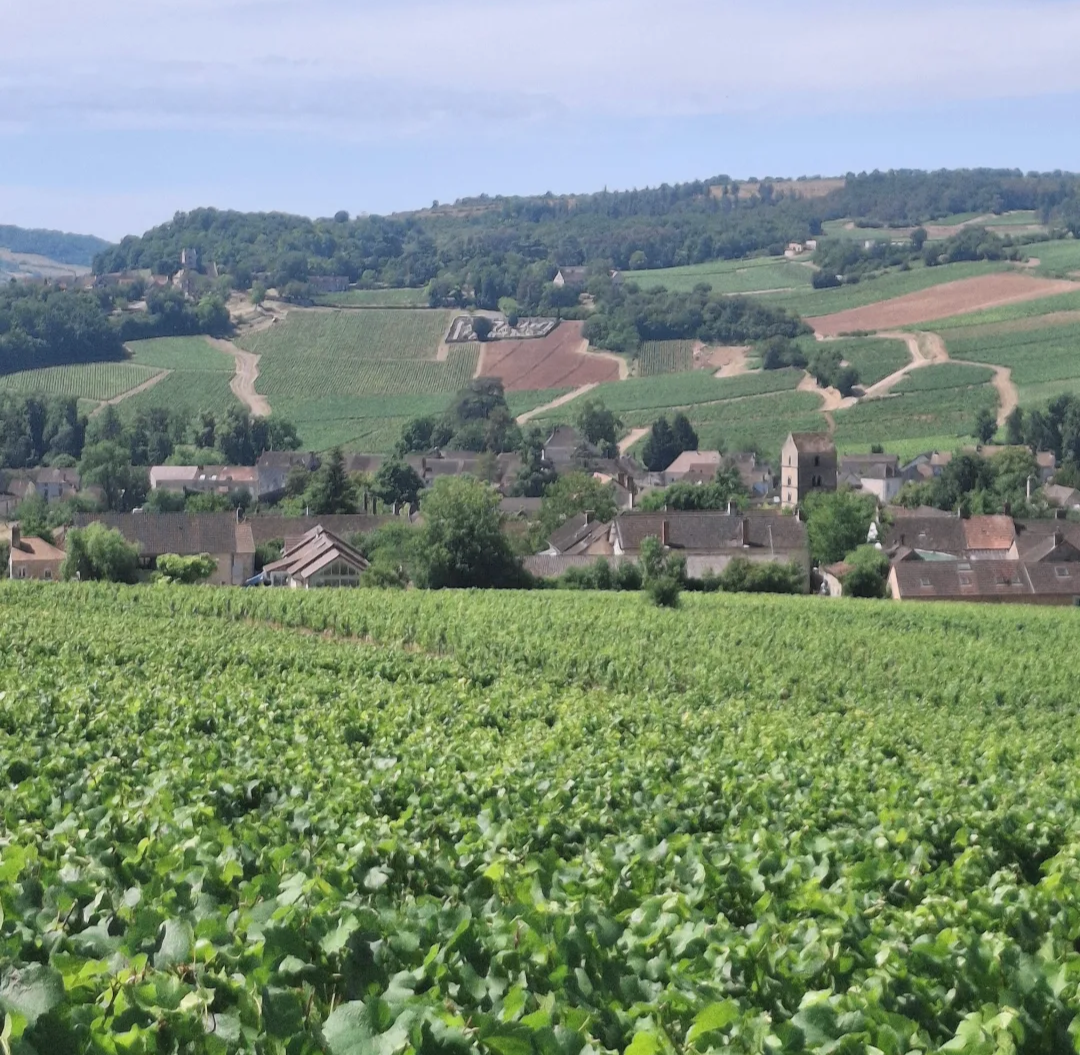
Our final day in Burgundy and it felt like a fitting way to end the week.
After a few days spent visiting producers across the Côte de Beaune and Côte de Nuits, we headed south to the Côte Chalonnaise to spend the day with Fred Gouffier, one of the most progressive winemakers we work with.
If there's been one theme running through almost every conversation on this trip, it's change.
Not small change.
Big change.
The kind of change that forces people to rethink how they farm, how they make wine and what the future of Burgundy might look like.
We've felt it ourselves.
Over the past week we've seen temperatures hit 39 degrees. By the time we leave Burgundy, they're forecasting 42 degrees, which would be a record.
That's hard to imagine when you're standing in vineyards that built their reputation on cool-climate Chardonnay and Pinot Noir.
Fred summed it up perfectly.
He said Burgundy today feels like the Rhône Valley did twenty years ago.
When you hear that from someone who works these vineyards every day, it really makes you stop and think.
The good news is that the best producers in Burgundy aren't standing still.
They're adapting.
And Fred is a great example of that.
We started working with Fred last year and one of the reasons we were drawn to his wines is that they're never dull.
Everything is certified organic, which is still relatively uncommon in Burgundy, and he's constantly experimenting, looking for ways to improve both quality and sustainability.
His home is Mercurey, in the Côte Chalonnaise, an area that has traditionally offered some of Burgundy's best value.
Nothing is cheap in Burgundy anymore, but Mercurey remains one of the regions where you can still find exceptional wines without paying the eye-watering prices of some of the more famous villages further north.
The wines are fantastic, but what really interested me yesterday was where Fred thinks Burgundy is heading.
One of the projects he's most excited about is a small planting of Melon de Bourgogne.
Most people know it as the grape behind Muscadet, but it actually originated in Burgundy.
The attraction is simple: it naturally holds onto acidity, even in warmer conditions.
As temperatures rise, growers across Burgundy are starting to think very differently about which grape varieties might thrive in the future.
Aligoté is another example.
We've talked a lot about Aligoté over the last couple of years and it feels like the momentum behind the variety is only getting stronger.
For a long time it was considered Burgundy's forgotten grape.
Not anymore.
Many of Burgundy's most exciting producers are now treating it with the same care and attention once reserved only for Chardonnay.
We also tasted a number of wines aged in amphora, the large clay vessels that are becoming increasingly popular with forward-thinking producers.
What fascinated me was how fresh the wines felt.
Technically, the numbers weren't dramatically different, but the wines had an energy and vibrancy that really stood out.
It's exactly the sort of experimentation that keeps Burgundy moving forward.
As much as I love the history and tradition of Burgundy, one thing this trip has reinforced is that the region's future will belong to producers who can adapt.
The climate in Burgundy is changing.
Harvest dates are moving earlier.
Water is becoming more important.
The old way of doing things won't always be enough.
A generation ago, many Burgundy producers were picking grapes in late September or even October.
Today, they're talking about harvesting in mid-August.
That's an extraordinary shift in a relatively short period of time.
For wine lovers, Burgundy remains one of the most fascinating wine regions in the world. But it's also one of the regions changing fastest.
Talking to producers throughout this trip, it's clear that climate, farming practices and grape varieties are becoming part of everyday conversations. The challenge now is preserving everything people love about Burgundy while adapting to a very different future.
And yet, despite all of these challenges, I came away feeling optimistic.
The producers we've met aren't burying their heads in the sand.
They're experimenting.
They're learning.
They're investing.
And they're determined to leave their vineyards in a better position for the next generation.
In many ways, that feels like the perfect note to end our time in Burgundy.
We've spent the past week meeting talented young winemakers, discovering new producers and seeing firsthand how one of the world's great wine regions is evolving.
Tomorrow we head south.
But Burgundy has certainly given us plenty to think about.

Share:
France Buying Trip 2026: Day 9 – You Can't Buy Everything
France Buying Trip 2026: Day 11 – The Best Discoveries Aren't Always Planned