After a few busy days on the road, today felt a little different.
There was no rushing between appointments, no long drives across multiple regions and no trying to squeeze three visits into one day.
Instead, it felt like a proper Loire Valley Sunday.
The day started with what felt like a major breakthrough after nearly a week in France: a genuinely decent coffee.
Combined with a croissant and a pastry, it was enough to convince me that I might finally be getting over the jet lag.
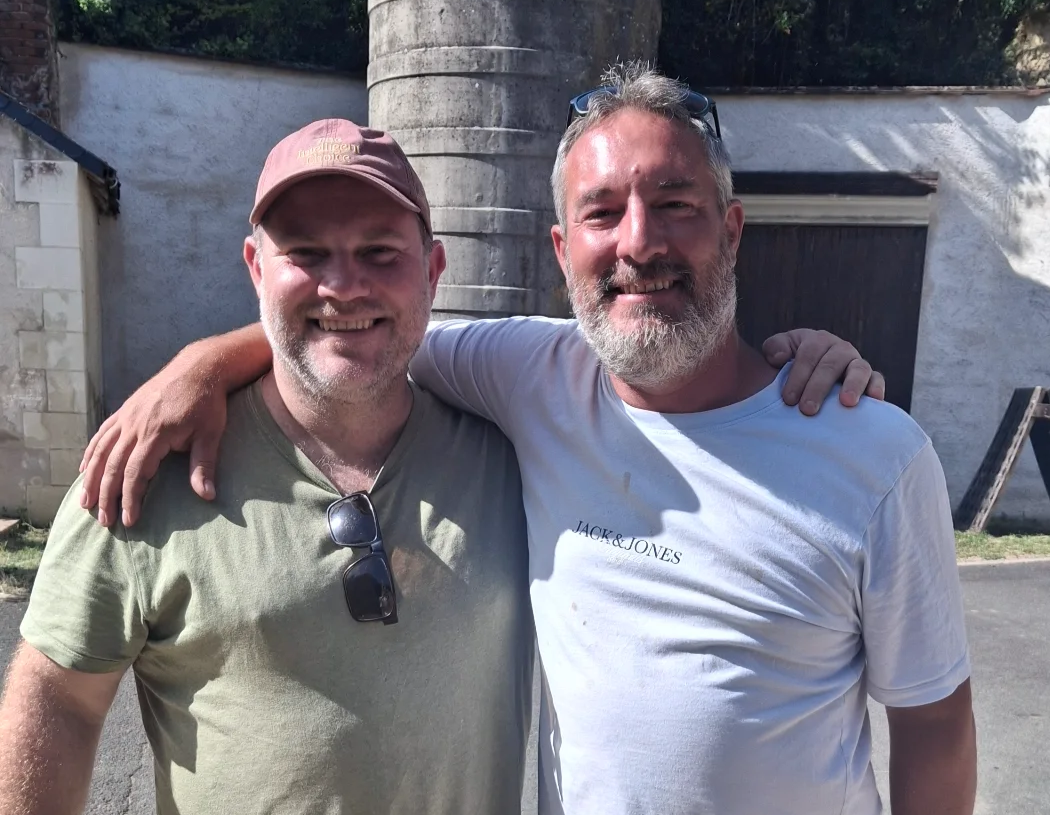
From Chinon, we made the hour-long drive north to Vouvray to spend the day with our producer, Benjamin Séré.
Ben lives in a small hamlet above the village, surrounded by vineyards and tucked away among some of the most highly regarded sites in the appellation. It's exactly the sort of place people imagine when they think about French wine country.
What I love most about Ben's story is that wine wasn't his first career. Before becoming a winemaker, he was a chef.
And not just any chef.
He worked in Michelin-starred restaurants in Paris, including a three-star restaurant, before eventually returning home to the Loire Valley.
He later opened a restaurant with a friend and spent more than a decade running it. But once he started a family, the lifestyle became harder to sustain.
Late nights.
Early mornings.
Very little family time.
Eventually he decided he wanted something different.
So he went back to school, studied winemaking and started working harvests and apprenticeships with some of the region's best producers, including Vincent Carême.
At the same time, he began making tiny amounts of wine on weekends from a rented 1.6-hectare vineyard. Slowly, year by year, he built what is now a 6.5-hectare estate.
Talking to producers throughout this trip, six or seven hectares seems to be a number that comes up often.
It's about as much vineyard as one person can realistically farm themselves while still maintaining the attention to detail required for organic viticulture.
Ben has no interest in becoming a large producer.
His focus is entirely on quality.
And you can see that everywhere.
Walking through his vineyards was probably the highlight of the day.
His parcels sit on some of the most sought-after sites in Vouvray, including holdings in Le Bouchet and La Grande Dame, alongside some of the region's most respected producers.
But what stood out wasn't the reputation of the vineyards.
It was how alive they felt.
Ben is one of the most committed organic growers we work with and has become increasingly focused on biodiversity and agroecology.

Between vineyard parcels he's planted native grasses, trees and cover crops.
He's planting fruit trees among the vines.
There were butterflies everywhere.
Lizards darting through the rows.
The whole vineyard felt alive.
What made it even more striking was seeing neighbouring vineyards nearby that were being farmed more conventionally. The contrast was impossible to ignore.
One vineyard felt like an ecosystem.
The other simply looked like a crop.
It's the sort of thing that's hard to understand until you see it with your own eyes.
Of course, all of that work ultimately has to show up in the glass.
Thankfully, it does.
Ben's wines are some of the most distinctive Vouvrays we import.
Traditional Vouvray can often lean towards richer, more oxidative styles.
Ben's wines feel fresher and more precise, with incredible energy running through them.
There's always a line of acidity carrying the wines from start to finish, but without losing the texture and generosity that makes Chenin Blanc such a fascinating grape variety.
We tasted through the full range, including La Traditionnelle, his sparkling Vouvray, which many Vintrepid customers will already know.
We revisited Les Trois Chênes, his flagship cuvée, as well as the single-vineyard wines from Le Bouchet and La Grande Dame.
Each wine felt different, but all carried the same signature style.
We also tasted an unreleased Pétillant Naturel that definitely caught my attention.
Watch this space.
Like so many visits on this trip, though, the highlight wasn't really the tasting.
It was lunch.
Ben fired up the barbecue while his kids swam in the pool.
There were radishes from the garden, tomatoes from a neighbour, beautiful local meat and a few bottles shared between friends.
We opened a bottle of Champagne we'd brought from earlier in the trip and spent a few hours talking about wine, family, business and everything in between.
Before we knew it, lunch had rolled into the afternoon.
We eventually left around 5:30pm, although I suspect Ben would have happily kept going for several more hours.
As we drove away, I couldn't help thinking how well the day summed up what makes the Loire Valley so special.
People often talk about Burgundy or Bordeaux when they think about French wine.
But the Loire quietly goes about its business, producing some of the country's most exciting wines without much fuss.
Beautiful villages.
Rolling vineyards.
Historic cellars.
Great food.
And some of the most interesting winemakers you'll ever meet.
Tomorrow we leave the Loire behind and head to Chablis.
But after spending a few days here, it's hard not to feel that this remains one of France's most underrated wine regions.
And days like today are a big part of the reason why.

Share:
France Buying Trip 2026: Day 4 – Why It's About More Than Wine
France Buying Trip 2026: Day 6 – The Search for Chablis