We stayed overnight in Chablis and headed into another full day of tastings on Tuesday.
By this point, the challenge wasn't finding good wine.
The challenge was deciding between good wines.
The more time we've spent in Chablis, the more I've realised that choosing a producer here is very different to choosing one in somewhere like the Loire Valley or Champagne.
In those regions, the differences between producers can feel quite dramatic.
In Chablis, most producers are working with the same grape variety, similar winemaking techniques and broadly similar limestone-rich soils.
The wines are different, but often in more subtle ways.
That means the decision comes down to details.
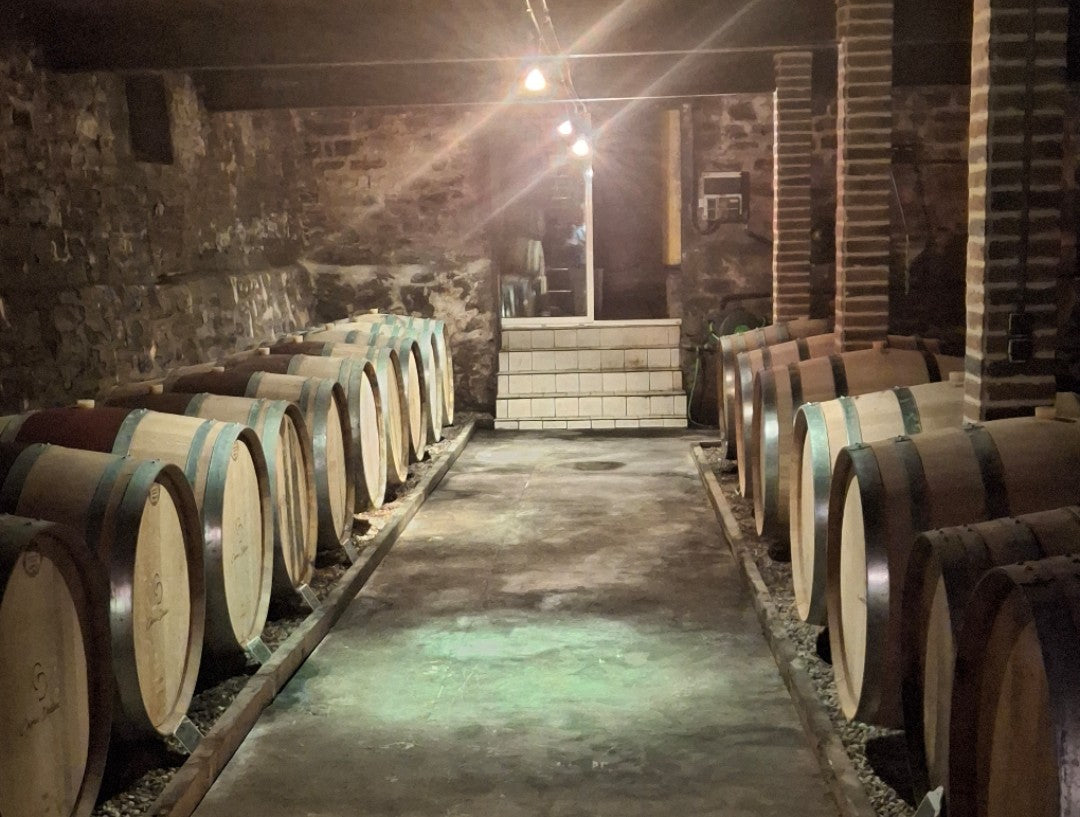
The first visit of the day was with Famille Savary.
We'd been tipped off about them because they're imported into the United States by Kermit Lynch, one of the most respected wine importers in the business.
The domaine is run by brothers Matthieu and Maxime Savary and farms around 20 hectares in Chablis.
Matthieu took us through the range and we were impressed from the start.
The wines had a consistency that a lot of producers struggle to achieve.
From Petit Chablis right through to the Premier Crus, every wine felt like it belonged to the same family.
The standout for me was actually a Vieilles Vignes Chablis.
Made from older vines and aged with a small amount of older oak, it had a little more texture and depth than many of the Premier Crus we'd tasted elsewhere.
In fact, it probably outperformed a few of them.
The wines weren't cheap, but they weren't expensive either.
To give you an idea, they would probably retail in Australia for around $70 a bottle rather than $60 for some of the producers we'd seen the day before.
For that jump in quality, it felt very reasonable.
Just as importantly, we really liked Matthieu.
He was humble, thoughtful and clearly obsessed with the details.
The family ferments with indigenous yeasts throughout the range and there was a real sense that nothing was being rushed or overcomplicated.
By the end of the tasting, they were firmly in contention.
After lunch — we're trying very hard to eat more salads after a week of pastries, cheese and terrines — we headed to our second appointment with Domaine Cyril Testut.
The wines here have a huge reputation and it's easy to understand why.
They were exceptional.
In fact, some of the wines may have been the best we tasted in Chablis.
But the visit highlighted something we've spoken about a lot on this trip.
Choosing a producer isn't just about the wine.
A few years ago, Cyril sold the domaine to the Brocard group, one of the larger wine businesses in Chablis.
He's still involved in making the wines, which is important, but the setup feels more commercial than many of the family estates we've visited.
Instead of tasting with Cyril himself, we were hosted by a brand manager.
There's absolutely nothing wrong with that.
But it creates a different experience.
One of the things we value most at Vintrepid is the relationship with the people behind the wines.
We like sitting around kitchen tables.
We like hearing stories firsthand.
We like knowing exactly who we're working with.
The wines were incredible.
But the connection felt different.
And that's part of the decision too.
By the end of the day, I think we'd narrowed the field considerably.
The challenge now is working out what role Chablis plays in the portfolio.
Do we want a producer whose wines can be poured by the glass in restaurants?
Do we want something more premium?
Can we do both?
Those are the questions we're trying to answer.
The good news is that we've got samples from all the producers we've visited.
When we get to Burgundy, we'll line them up and taste everything blind.
No labels.
No stories.
Just the wines.
It's probably the fairest way to do it.
For now, Chablis remains one of the toughest decisions of the trip.
But that's probably a good sign.
After all, it's much better to have too many good options than not enough.

Share:
France Buying Trip 2026: Day 6 – The Search for Chablis
France Buying Trip 2026: Day 8 – Burgundy's Rising Stars